Picture the refrigerator door. Under a magnet shaped like a pineapple sits a printed sheet from three weeks ago: eight exercises, each with a stick-figure drawing, “10 reps, 2x daily.” The parent meant to do it. Then a sibling got sick, the car needed a repair, and bedtime turned into a battle. The sheet is still there. The exercises are not happening.
Most clinicians have written that sheet. The research points to a different approach: fewer activities, built into routines the family already has, taught by coaching the parent in the room, and checked on every week. (If you want to bill for that weekly check, see how remote therapeutic monitoring billing works.)
Most home programs are not followed as written
In a 2022 survey of 113 mothers of children with cerebral palsy who had been prescribed a home exercise program by a physical therapist, 66.1% did not follow it. The authors also found that how the therapist treated the mother influenced compliance.1
66.1%
That was one self-report survey in Saudi Arabia, so it does not tell you the rate in your clinic. It does match what many of us see, including the part about the relationship.
When parents are taught, parent-delivered intervention works
Roberts and Kaiser’s 2011 meta-analysis of 18 studies found that parent-implemented language interventions had a significant, positive impact on receptive and expressive language for children aged 18 to 60 months. Effect sizes ranged from -0.15 to 0.82 depending on outcome and comparison.2 These were structured programs that trained parents in specific strategies, not take-home worksheets.
In occupational therapy, Novak, Cusick and Lannin ran a double-blind randomized trial with 36 school-aged children with cerebral palsy. Eight weeks of collaboratively built home programs produced significant gains in function and parent satisfaction compared with no home program, at about 17.5 sessions a month averaging 16.5 minutes.3
17.5
Not twice a day. Not even every day. A program that fits a family’s real week can work.
Fewer activities, attached to routines the family already has
In focus groups with 28 parents of children with physical disabilities, the number, complexity and perceived effect of exercises determined how much time a program took and how burdensome it felt. Parents adhered better when the physiotherapist built their confidence, helped fit the program into daily routines, and kept motivation up.4
So pick two or three activities that map to your current goals, and add one only when an old one is happening reliably.
If you would not be upset to see an activity skipped, it does not belong on the sheet.
Asking a family to find a new 20-minute slot means asking them to give something else up. ASHA’s early intervention guidance describes routines-based intervention as “using everyday activities as a context for embedded instruction.”5 The idea works past age three.
| Routine | Speech | OT | PT |
|---|---|---|---|
| Bath | Name body parts, pause for the child to fill in | Squeeze sponges, pour between cups | Step in and out holding the edge |
| Meals | Offer a choice and wait | Self-feeding with an adapted spoon | Sit without back support for part of the meal |
| Getting dressed | “Arms up” or “shoes on” requests | Push arms through sleeves, try buttons | Stand on one foot to put on pants |
Teach in more than one routine. In a study of the Teach-Model-Coach-Review approach, caregivers learned strategies in clinic but generalization at home was limited, and the authors concluded that teaching across routines is necessary.6
Coach the parent; don’t just hand over a sheet
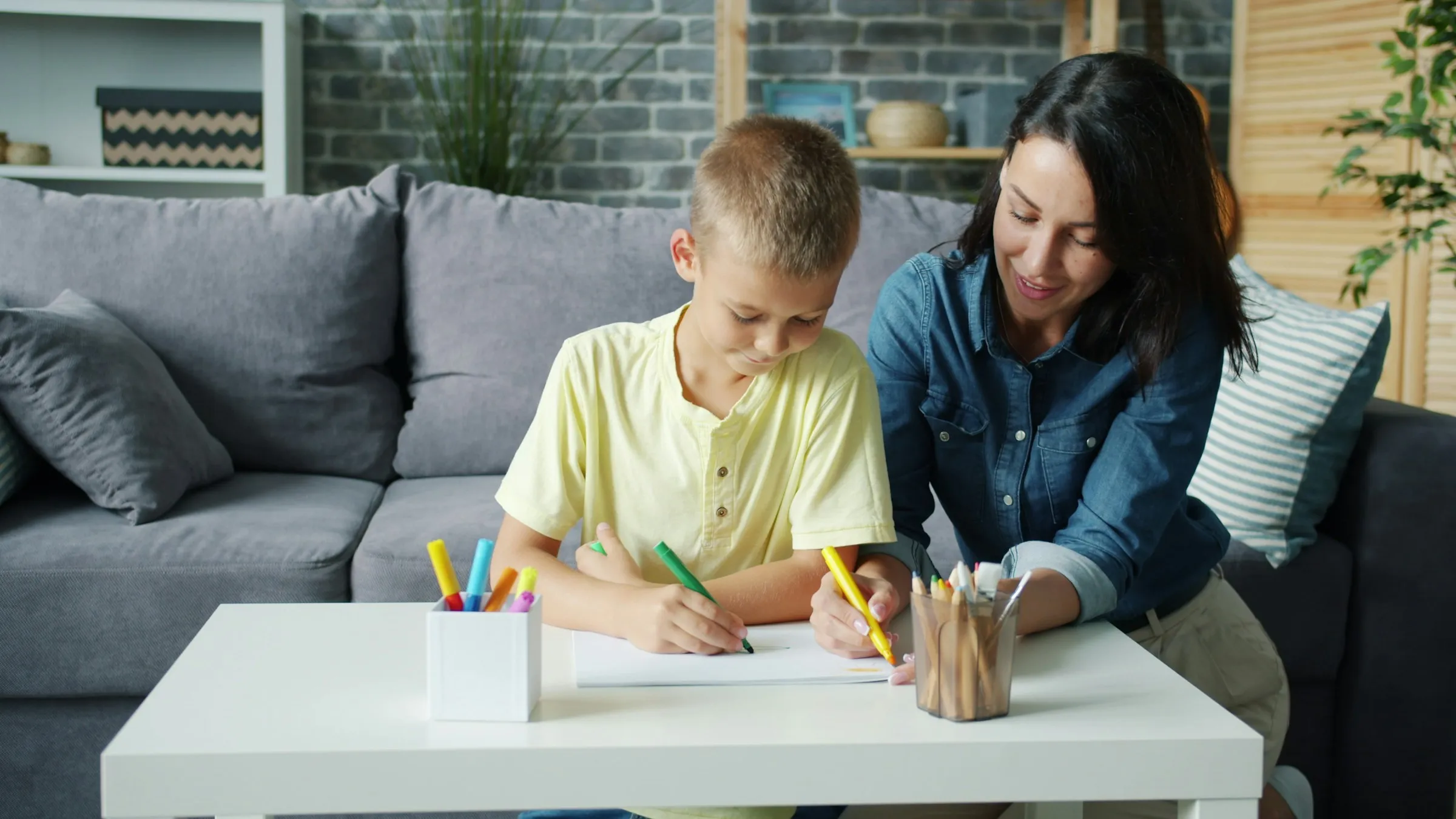
A handout tells a parent what to do. Coaching shows them how and watches them try. Teach-Model-Coach-Review is one well-studied version: explain the strategy, demonstrate it, coach the parent live, then review what worked.6 ASHA lists coaching’s components as joint planning, observation, action or practice, reflection, and feedback.5 In a 45-minute session:
- First 5 minutes: ask how the week went and what got in the way.
- Next 10: model the activity while the parent watches for one thing you name in advance.
- Next 15: the parent does it, and you coach in short phrases (“wait a little longer”).
- Last 5: agree on the week’s plan, in the parent’s words.
That coaching time is the intervention.
A phone video of the parent doing the activity with their own child, recorded at the end of a session, often beats a printed sheet. The pediatric evidence is thin; the closest randomized evidence is a pilot trial of 56 adults after stroke, where video-guided home exercise produced 75.6% adherence at three months versus 55.2% for a paper pamphlet.7 Treat it as a hint, not proof, and follow your clinic’s policy on where videos are stored.
Respect the family’s capacity, culture and language
A program written for an imaginary family with a quiet evening and English as a first language will fail many real ones. ASHA’s guidance is to provide services in the language the family is most comfortable using and teach strategies in their home language; early exposure to multiple languages does not cause language delay.5 In a small randomized trial, 21 Spanish-speaking caregivers taught enhanced milieu teaching in Spanish used the strategies significantly more, and their children’s receptive vocabulary scores were significantly higher than controls.8
A 2026 systematic review of 37 studies found parents rarely cast as collaborative decision-makers.9 Ask before you prescribe: “Which part of the day would be easiest for this?” and “What does a hard week look like at your house?”
A one-page home program template
Fill this in with the family during the last five minutes, in their preferred language.
Home plan for: child’s first name · Dates: this week through next session
What we’re working on: one sentence in family words
Activity 1: what to do
- When: which routine
- How often and how long: a realistic number
- It’s working when: what the parent will see
- If they resist: one simple fallback
Activity 2: same fields
Track it: tick a box each day you tried, or text us one sentence
Next session we’ll ask: one specific question
Speech example (age 2, late talker)
- Working on: asking for things with words instead of pulling you to the fridge.
- Activity: At snack, hold up two choices, say both names, then wait five seconds. It’s working when: he tries any word or sound. If he melts down: name it, give it, try tomorrow.
- Next session: “Which snack choices did he try to say?”
OT example (age 5, fine motor and self-care)
- Working on: doing up her own jacket zipper before school.
- Activity: Practice starting the zipper with the jacket on a chair, then on her, about 5 tries while you pack lunch. It’s working when: she starts it with only a little help.
- Next session: “On how many mornings did she start the zipper herself?”
PT example (age 7, after a leg fracture)
- Working on: stairs without holding the rail with both hands.
- Activity: Walk up to bed one hand on the rail, foot over foot, with you one step behind. It’s working when: she does a full flight without stopping. If she’s tired: do half.
- Next session: “Did any part of the stairs feel hard or scary?”
These illustrate format, not prescriptions. Each child’s activities, dose and safety precautions are for the treating clinician to decide.
Close the loop every single session
The adherence research keeps returning to the therapist’s behavior.41 The simplest habit that covers it is to open each session by asking about the home plan, without judgment, and adjust based on the answer.
“We didn’t get to it” is information, not failure. Shrink the plan, move it to a different routine, or ask what would make it possible. A short plan that happens beats a complete plan that stays on the fridge.
Footnotes
-
Alwhaibi RM, Omer AB, Khan R. “Factors Affecting Mothers’ Adherence to Home Exercise Programs Designed for Their Children with Cerebral Palsy.” International Journal of Environmental Research and Public Health, 2022. ↩ ↩2
-
Roberts MY, Kaiser AP. “The effectiveness of parent-implemented language interventions: a meta-analysis.” American Journal of Speech-Language Pathology, 2011. ↩
-
Novak I, Cusick A, Lannin N. “Occupational therapy home programs for cerebral palsy: double-blind, randomized, controlled trial.” Pediatrics, 2009. ↩
-
Lillo-Navarro C, et al. “Parents of children with physical disabilities perceive that characteristics of home exercise programs and physiotherapists’ teaching styles influence adherence: a qualitative study.” Journal of Physiotherapy, 2015. ↩ ↩2
-
American Speech-Language-Hearing Association. “Early Intervention.” Practice Portal. ↩ ↩2 ↩3
-
Roberts MY, Kaiser AP, Wolfe CE, Bryant JD, Spidalieri AM. “Effects of the teach-model-coach-review instructional approach on caregiver use of language support strategies and children’s expressive language skills.” Journal of Speech, Language, and Hearing Research, 2014. ↩ ↩2
-
Chung BPH, et al. “Pilot study on comparisons between the effectiveness of mobile video-guided and paper-based home exercise programs.” Hong Kong Physiotherapy Journal, 2020. ↩
-
Peredo TN, Mancilla-Martinez J, Durkin K, Kaiser A. “Teaching Spanish-Speaking Caregivers to Implement EMT en Español: A Small Randomized Trial.” Early Childhood Research Quarterly, 2022. ↩
-
Amaya-Medina DR, Spencer Contreras RE, González-Fernández DF. “Parental Roles in Language Intervention: A Systematic Review.” American Journal of Speech-Language Pathology, 2026. ↩