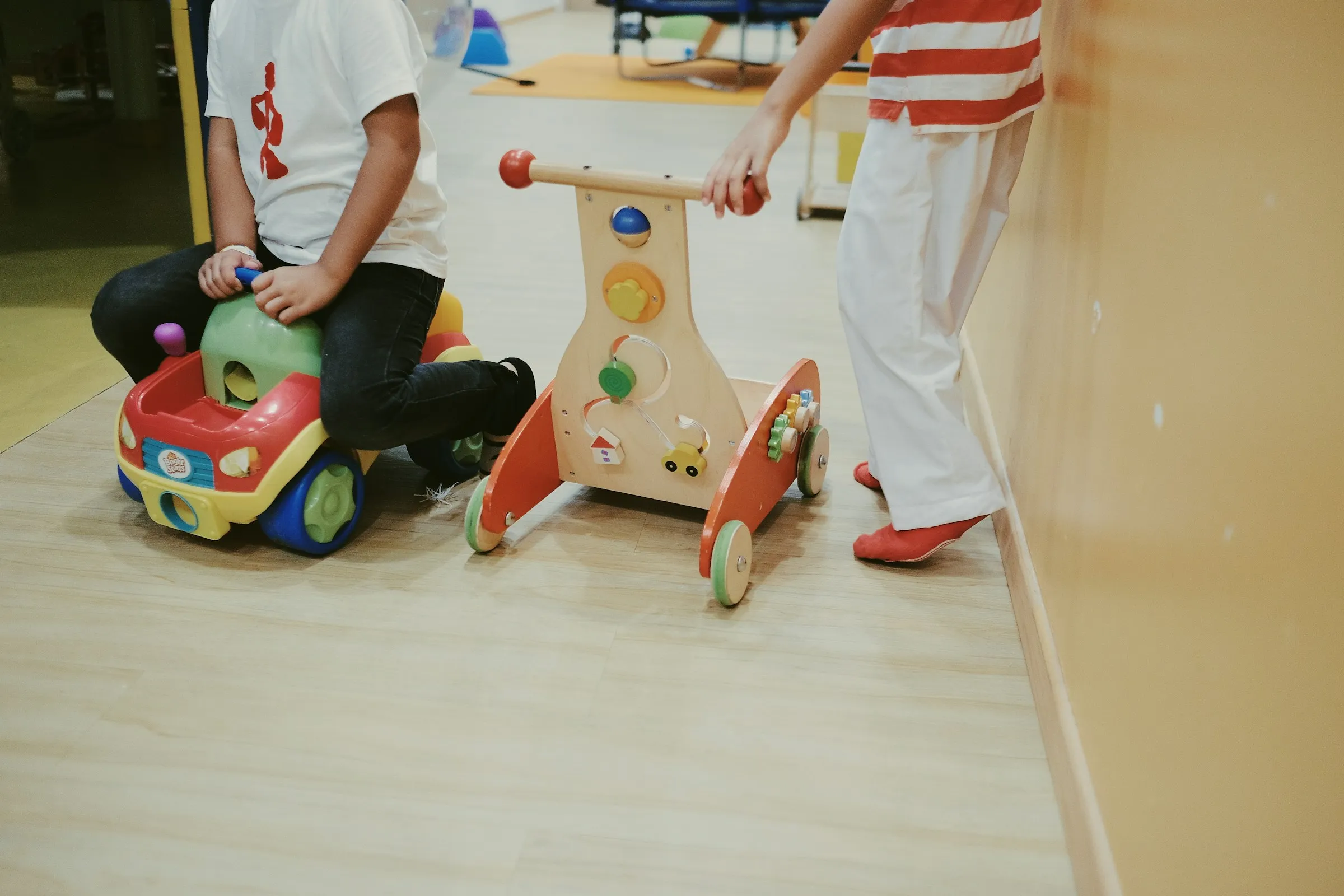
Picture a hypothetical 4-year-old in a PT gym on a Wednesday afternoon. In 40 minutes she does bear walks across a mat, stands on a wobble cushion popping bubbles, and climbs foam stairs to post puzzle pieces. To her, it was one game. To the claim, it might be three codes or one, depending on why the therapist chose each activity and how the minutes were written down.
Pediatric therapy runs on play. The 97000-series codes were written in adult language: strength, proprioception, functional performance. This guide maps one onto the other, using what CMS and its contractors have actually published.
Three descriptors, three different questions
CPT descriptors belong to the AMA, but Medicare contractors reprint them in their billing articles. Here they are as one contractor publishes them:1
| Code | Descriptor | The question it answers |
|---|---|---|
| 97110 | “Therapeutic Exercises to develop strength and endurance, range of motion and flexibility (one or more areas, each 15 minutes)” | Is the child getting stronger, more flexible or able to go longer? |
| 97112 | “Neuromuscular Re-education of movement, balance, coordination, kinesthetic sense, posture, and/or proprioception for sitting and/or standing activities (one or more areas, each 15 minutes)” | Is the child learning to control the body: balance, posture, coordination? |
| 97530 | “Therapeutic Activities, direct (one-on-one) patient contact (use of dynamic activities to improve functional performance), each 15 minutes” | Is the child practicing a real task that combines those abilities? |
Two neighbors matter in pediatric OT. 97535 covers self-care and home management training, such as activities of daily living and adaptive equipment, with direct one-on-one contact.1 97533 covers “sensory integrative techniques to enhance sensory processing and promote adaptive responses to environmental demands, direct (one-on-one) patient contact, each 15 minutes.”2
Code the purpose, not the toy
The clearest line in the contractor guidance is about a gym ball. A gym ball exercise used to increase strength is coded as therapeutic exercise, 97110. The same ball used to improve balance is neuromuscular re-education, 97112.1
That is the whole decision in miniature. Bubbles, swings, scooter boards and obstacle courses are not codes. The goal you wrote in the plan of care, and the reason you chose this activity today, decide the code.
Here is how the hypothetical PT session above might be split:
| Activity | Documented purpose | Code (minutes) |
|---|---|---|
| Bear walks, resisted sit-to-stand from a low bench | Hip and shoulder strength needed for stair climbing | 97110 (12) |
| Standing on a wobble cushion, reaching for bubbles outside her base of support | Standing balance and postural control | 97112 (14) |
| Obstacle course: climb four foam steps carrying a beanbag, step over a beam, squat to pick up and return | Multi-step functional mobility for the school playground | 97530 (16) |
| Bathroom break, shoes off | Not treatment | Not counted |
That is 42 timed minutes. Under Medicare’s method, which totals all timed minutes for the day, 42 minutes supports three units, one per code.3 A payer that counts each code separately under the CPT midpoint rule also lands on three here, but the two methods often disagree. Our guide to the 8-minute rule vs the midpoint rule works through the cases where they split.
The same ball can be two different codes. What changes is the sentence explaining why.
One-on-one is written into 97530
The 97530 descriptor names direct one-on-one contact. 97110 and 97112 do not say it in their titles, but Medicare treats timed therapy codes as direct contact codes. The Claims Processing Manual describes several therapy codes as specifying that “the direct (one on one) time spent in patient contact is 15 minutes.”3 The contractor article is blunter: timed services “require direct, one-on-one patient” contact and “cannot be billed when performed in a supervised manner.”1
The test is how your attention was spent. If a therapist moves between two children a minute or two at a time, the contractor’s example codes one unit of 97150 (group) for each child. If the therapist tracks distinct one-on-one episodes, each child’s one-on-one minutes are billed as the timed code, and the time they spend working on their own is not counted.1
For a pediatric gym, that means a shared turn-taking game with two kids is group time. Minutes billed as 97530 should be minutes when one child had your hands and eyes.
What the edit files say as of October 2026
NCCI edits are where a correct note still gets a line denied. Medicare’s policy manual says providers “shall not report more than one physical medicine and rehabilitation therapy service for the same fifteen-minute time period,” and that paired timed codes may be bypassed with modifier 59 or XU when done in different time intervals.4
From the Medicare practitioner procedure-to-procedure (PTP) file effective October 1, 2026:5
- 97150 with 97530, 97110, 97112, 97533 or 97535: active edits, modifier allowed. Group and individual time on the same day needs separate intervals and a modifier.
- 97530 with initial evaluations (97161 to 97163, 97165 to 97167): edits were added January 1, 2020 and deleted with that same date. None are active.
- Re-evaluations (97164, 97168): no active edit with 97530, 97110 or 97112, but 97533 and 97535 each have active edits with both re-evaluation codes. The policy manual adds that re-evaluations should not be reported routinely; when a child’s status changes, modifier 59 or XU goes on the re-evaluation code.4
- 97530 with ABA codes 97153 to 97158: active, modifier indicator 0, so no modifier bypasses it. NCCI edits apply to the same provider, the same patient and the same date of service.4
Medically unlikely edits (MUEs) cap units per day in the same quarter’s practitioner table: 97110 and 97530 at 6, 97112 and 97533 at 4, 97535 at 8, 97150 at 1, and each PT and OT evaluation and re-evaluation code at 1.6
4
These are Medicare files. Medicaid runs its own NCCI edit set and policy manual, which repeats the same 15-minute rule. Commercial plans use their own edits. Check yours before assuming an edit does or does not exist.
The 2027 payment gap is too small to code for
National non-facility amounts for 2027, using the final rule’s RVUs and the $32.6286 conversion factor, before geographic adjustment:78
| Code | Total RVUs | 2027 national amount |
|---|---|---|
| 97110 | 0.90 | $29.37 |
| 97112 | 1.01 | $32.95 |
| 97530 | 1.09 | $35.57 |
| 97535 | 1.00 | $32.63 |
| 97533 | 1.89 | $61.67 |
| 97150 | 0.55 | $17.95 |
Medicare also applies a multiple procedure payment reduction: the unit with the highest practice expense is paid in full, and later units the same day get 50% of their practice expense portion.3 Real payment per unit after the first is lower than the table.
$6.20
Six dollars is not worth an audit finding. 97533 shows the opposite risk: it pays the most, but one large commercial insurer’s policy effective November 1, 2026 lists sensory integration therapy as “unproven and not medically necessary,”2 and the Medicare contractor expects its use to be “infrequent for Medicare patients.”1 Before billing it, read each payer’s policy.
Note phrases that match the code
The contractor lists what notes should show for each code, at least every 10 visits: specific activities, their purpose related to function, instruction given and assistance needed.1 These hypothetical phrases follow that pattern. Edit them to match what happened; never paste one into a note it does not describe.
| Code | Phrase that supports it |
|---|---|
| 97110 | “Resisted sit-to-stand from 10-inch bench, 3 sets of 6, to build hip extensor strength for reciprocal stair climbing. Progressed from 4 reps last week. Verbal cues for trunk alignment.” |
| 97112 | “Static and dynamic standing balance on compliant surface with reaching outside base of support to improve postural control for playground mobility. 4 losses of balance needing min assist, down from 7.” |
| 97530 | “Multi-step obstacle course (climb 4 steps carrying object, step over beam, squat to retrieve) to improve functional mobility for school playground. Contact guard on steps, 2 cues for sequencing.” |
| 97535 | “Buttoning half-inch buttons on own jacket for independent dressing at school. Hand-over-hand faded to verbal cues. 3 of 5 buttons independent.” |
Write the minutes beside each code. Medicare only requires total timed minutes, but per-code minutes are what any payer using the midpoint rule needs, and what an auditor reads first.3
A quick decision table for the gym
| If the minutes were mainly for | Start with | Watch for |
|---|---|---|
| Strength, range of motion, endurance | 97110 | Repeating the same exercises with no progression |
| Balance, coordination, posture, body awareness | 97112 | MUE of 4 units per day |
| A functional task combining several abilities | 97530 | Must be one-on-one the whole time |
| Dressing, feeding, self-care routines | 97535 | Better code than 97530 for ADLs |
| Two or more children sharing your attention | 97150 | One unit per child, separate interval from timed codes |
- Every timed code in the note has its own minutes and its own purpose
- Group minutes are separated from one-on-one minutes
- Same-day ABA and OT schedules are checked against the 97530 edit
- Each payer’s unit-counting rule is written down
- 97533 is billed only to payers whose policy covers it
These are Medicare rules and federal edit files, which change every quarter. Confirm anything that affects a claim with your MAC, state Medicaid program, each commercial payer or your compliance adviser.
Footnotes
-
Centers for Medicare & Medicaid Services, Medicare Coverage Database. “Billing and Coding: Outpatient Physical and Occupational Therapy Services (A56566).” Wellpoint Federal. Accessed November 18, 2026. ↩ ↩2 ↩3 ↩4 ↩5 ↩6 ↩7
-
UnitedHealthcare. “Sensory Integration Therapy and Auditory Integration Training, Commercial and Individual Exchange Medical Policy.” Effective November 1, 2026. ↩ ↩2
-
Centers for Medicare & Medicaid Services. “Medicare Claims Processing Manual, Chapter 5, Part B Outpatient Rehabilitation and CORF/OPT Services,” sections 10.7 and 20.2. Accessed November 18, 2026. ↩ ↩2 ↩3 ↩4
-
Centers for Medicare & Medicaid Services. “NCCI Policy Manual for Medicare Services, Chapter XI,” sections P and W. Revised January 1, 2026. ↩ ↩2 ↩3
-
Centers for Medicare & Medicaid Services. “Medicare NCCI Procedure to Procedure (PTP) Edits,” practitioner file version 32.3, effective October 1, 2026. ↩
-
Centers for Medicare & Medicaid Services. “Medicare NCCI Medically Unlikely Edits,” practitioner services table effective October 1, 2026. ↩
-
Centers for Medicare & Medicaid Services. “CMS-1848-F: CY 2027 Physician Fee Schedule Final Rule,” Addendum B, updated November 5, 2026. ↩
-
American Speech-Language-Hearing Association. “2027 Medicare Part B Final Rule: Coding, Payment, and Policy Analysis.” November 10, 2026. ↩